Introduction
Two dice can create many different results, but some totals appear more often than others. Understanding these outcomes helps players learn the mathematics behind the 7 Up Down game. Instead of relying on lucky guesses or patterns, readers can use basic probability to understand how each dice total works.
If you are researching the 7up game download apk, learning the rules and possible dice combinations is a useful first step. The game generally involves predicting whether two dice produce a total below 7, exactly 7, or above 7. This guide explains all 36 possible outcomes, their probabilities, and the difference between mathematical chances and guaranteed results.
How Do Two Dice Create 36 Possible Outcomes?
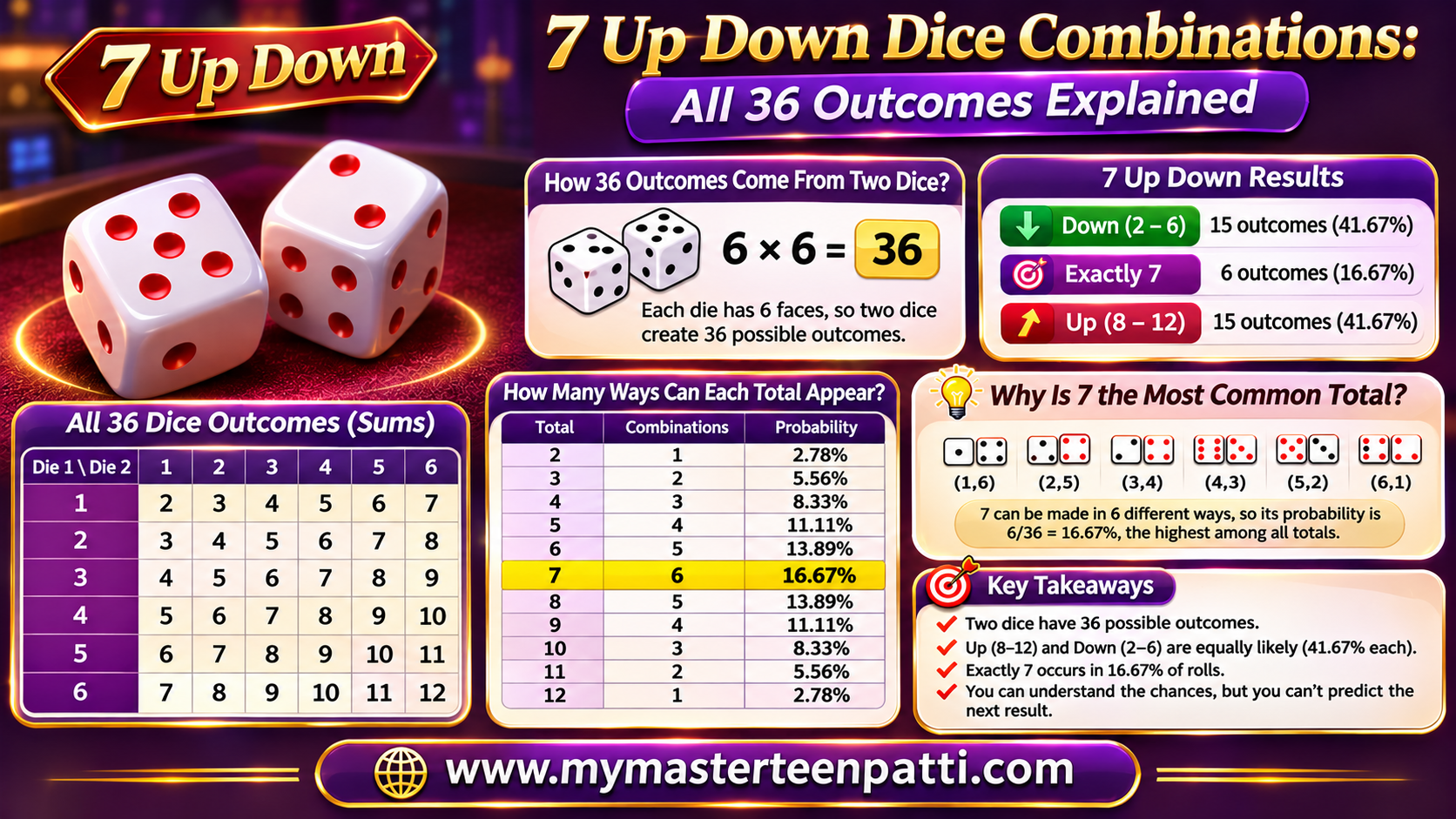
Each standard die has six faces, numbered from 1 to 6. When you roll two dice, the first die can show any of six numbers, and the second die can also show any of six numbers.
The total number of ordered outcomes is:
6 × 6 = 36 possible outcomes
For example, (2, 5) and (5, 2) count as two separate outcomes because the dice show different values in different positions. Both produce a total of 7, but they represent distinct results.
All 36 Dice Outcomes Explained
The following table lists every possible ordered outcome and the sum of the two dice.
| First Die | Second Die: 1, 2, 3, 4, 5, 6 |
|---|---|
| 1 | 2, 3, 4, 5, 6, 7 |
| 2 | 3, 4, 5, 6, 7, 8 |
| 3 | 4, 5, 6, 7, 8, 9 |
| 4 | 5, 6, 7, 8, 9, 10 |
| 5 | 6, 7, 8, 9, 10, 11 |
| 6 | 7, 8, 9, 10, 11, 12 |
Each row represents six possible outcomes. Together, these rows account for all 36 combinations.
For instance, rolling a 3 and a 4 produces 7, while rolling a 5 and a 6 produces 11. The lowest possible total is 2, and the highest is 12.
How Many Ways Can Each Dice Total Appear?
The number of combinations changes with the total. A sum of 7 has six possible combinations, while a sum of 2 or 12 has only one.
| Dice Total | Number of Outcomes | Probability |
|---|---|---|
| 2 | 1 | 2.78% |
| 3 | 2 | 5.56% |
| 4 | 3 | 8.33% |
| 5 | 4 | 11.11% |
| 6 | 5 | 13.89% |
| 7 | 6 | 16.67% |
| 8 | 5 | 13.89% |
| 9 | 4 | 11.11% |
| 10 | 3 | 8.33% |
| 11 | 2 | 5.56% |
| 12 | 1 | 2.78% |
These percentages assume two fair, independent six-sided dice. The probability of a total equals the number of outcomes that produce it divided by 36.
Why Is 7 the Most Common Dice Total?
Seven has six possible combinations: (1, 6), (2, 5), (3, 4), (4, 3), (5, 2), and (6, 1).
Therefore, its probability is 6/36, or approximately 16.67%. No other total has as many possible outcomes.
However, 7 is still not guaranteed to appear on the next roll. Even if several previous rolls produced different totals, the probability of getting 7 remains approximately 16.67% when the dice are fair and each roll is independent.
Understanding Up, Down, and Exactly 7
The standard three-outcome format divides the totals into three groups:
-
Down: Totals from 2 to 6, representing 15 of 36 outcomes, or 41.67%.
-
Exactly 7: Six outcomes, representing 16.67%.
-
Up: Totals from 8 to 12, representing 15 of 36 outcomes, or 41.67%.
Up and Down have equal probabilities because their totals mirror each other around 7. Neither option has a 50% probability because exactly 7 forms a separate category.
Actual payouts may differ from these probabilities. Always check the game's displayed rules and payout table before participating.
Can Dice Combinations Predict the Next Result?
Probability explains possible outcomes, but it cannot guarantee the next result. Previous rolls do not make a particular total more likely on the next independent roll.
Players should also avoid assuming that a long sequence of Up or Down results must immediately reverse. Random results can produce short streaks without following a predictable pattern.
Understanding probability can improve mathematical awareness, but it does not create a guaranteed winning strategy. If a game involves real money, set a strict spending limit, avoid chasing losses, and follow the laws applicable to your location.
Conclusion
Learning all 36 dice outcomes makes the 7 Up Down game easier to understand from a probability perspective. The key takeaway is simple: totals have different probabilities, exactly 7 has six possible outcomes, and neither Up nor Down represents a 50% chance under the standard rules. Use the mathematics to understand the game rather than to assume you can predict random results.
Readers researching the 7up down game apk should review the official page, check the app's authenticity and permissions, verify local legal restrictions, and understand any financial risks before deciding whether to proceed.